
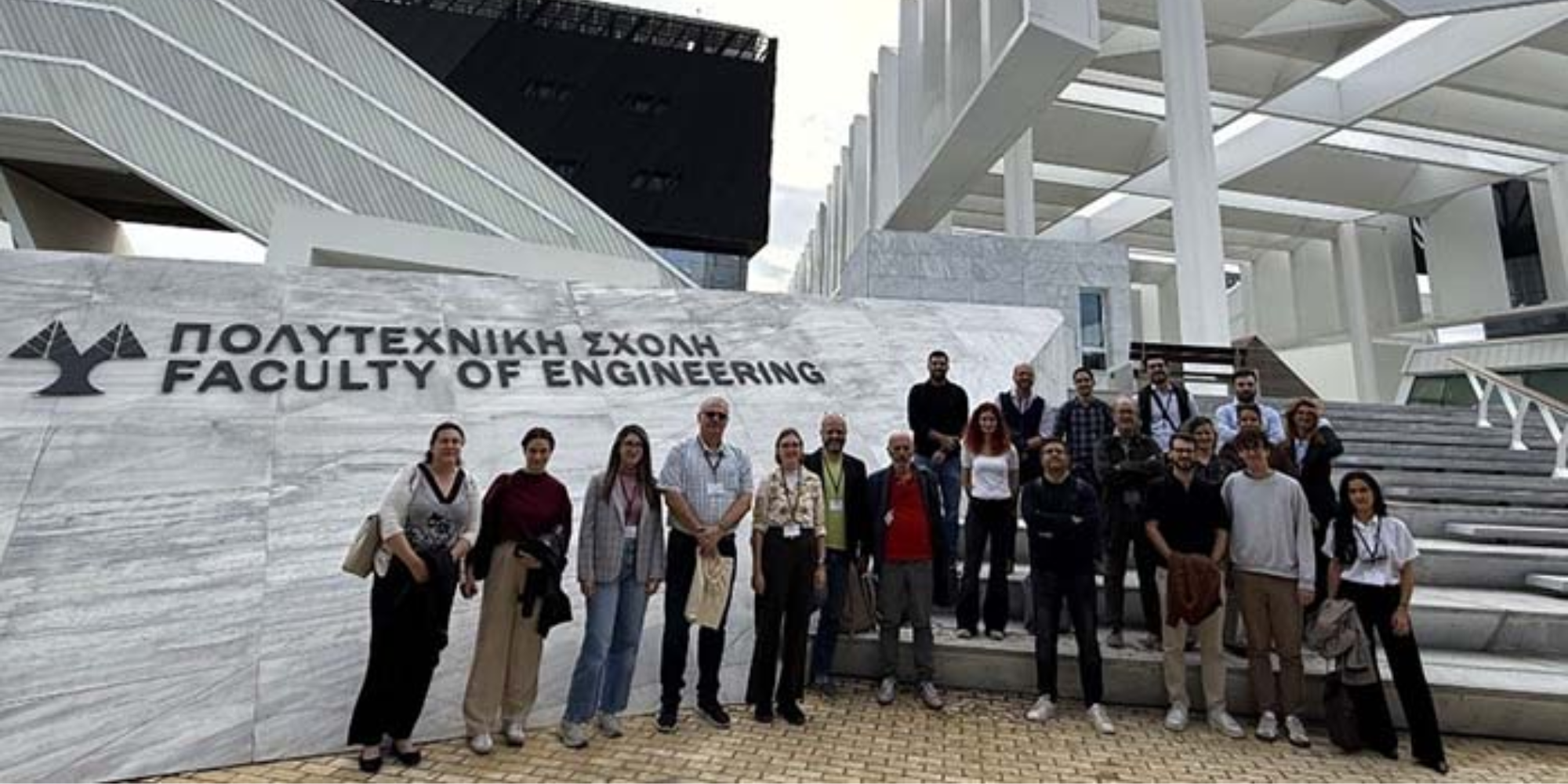
The safety of drinking water and the new European requirements are at the forefront, with the University of Cyprus and Limassol serving as key reference points in the project.
A highly productive two-day meeting of the European research project intoDBP (Innovative Tools to Control Organic Matter and Disinfection Byproducts in Drinking Water – https://intodbp.eu) took place in Cyprus. The University of Cyprus (UCY), as an important partner and host, ensured excellent hospitality for the consortium partners. The meeting further strengthened collaboration ahead of the project’s final stages, which aim to safeguard the quality of drinking water for the general public.
Drinking water quality is a central public health issue. With the recent revision of the European Drinking Water Directive, water suppliers in all Member States are required to implement stricter standards for chemical substances formed during disinfection. The intoDBP project develops technologies and tools that support water treatment plants in effectively responding to these new requirements.
The intoDBP Project: Objectives, Funding and Partners
The intoDBP project, with a total budget of €3,994,708, is funded by the European Union’s Horizon Europe programme. The consortium consists of 18 partners in total (research institutions, companies and public bodies). The project coordinator is Fundació Institut Català de Recerca de l’Aigua (ICRA) in Spain.
Cypriot partners play a key role, as Limassol is one of the four European regions where the project’s new technologies are being piloted. Cyprus will receive a total of €856,071, underscoring the country’s strategic role in EU drinking water research. Cypriot partners include:
- The University of Cyprus, through the Nireas and Kios Research Centres as well as the Departments of Chemistry and Psychology
- The Limassol District Development Agency (EΟΑΛ)
- The private company S.K. EUROMARKET LTD
Water Safety, Disinfection Byproducts (DBPs) and New Legislation
The intoDBP project focuses on reducing disinfection byproducts (DBPs) formed during water chlorination, with trihalomethanes (THMs) remaining the main quality indicator and at the centre of monitoring. The new EU Drinking Water Directive (2020/2184) introduces stricter standards and new limits for additional DBPs, such as chlorites, chlorates and haloacetic acids (HAAs).
intoDBP develops innovative solutions for upgrading water treatment facilities, ensuring compliance both with established THM limits and with the new regulatory requirements for additional DBPs.
Outcomes of the Cyprus Meeting
During the two-day meeting, intoDBP partners focused on reviewing progress and coordinating the next steps, with particular emphasis on practical applications:
- A visit took place to the Limassol Drinking Water Treatment Plant, one of the country’s most important facilities, producing up to 40,000 m³ of drinking water per day. Participants had the opportunity to see the MITO3X® pilot unit, which contributes to optimising water pre-treatment.
- Partners also visited the new Department of Civil and Environmental Engineering at the University of Cyprus, where they toured advanced research facilities and the University Library.
The University of Cyprus extends its sincere thanks to all partners for their active participation.
Information
intoDBP Project: https://intodbp.eu/
For further information:
Elena Marangou – maragkou.eleni@ucy.ac.cy
Dr Despo Fatta-Kassinou – dfatta@ucy.ac.cy (project coordinator for the University of Cyprus)
Source: University of Cyprus | Latest news (https://tinyurl.com/2s3kx7y8)