
SOPHIA-DN, funded under the Marie Skłodowska-Curie Actions, will train 15 doctoral researchers at leading centres of archaeological science across Europe
The University of Cyprus has secured funding from the European Commission for SOPHIA-DN, a large-scale research project entitled “A Doctoral Training Network on the Study Of Premodern Ceramic Heritage: Integrating Experimental and AI-Enhanced Interdisciplinary Research”. The project is funded under the Horizon Europe Marie Skłodowska-Curie Actions (MSCA) Doctoral Networks scheme, with an EU contribution of approximately €4.3 million over four years (2027-2031).
Securing this funding represents a major achievement for the University of Cyprus. SOPHIA-DN is the second programme of this scale that the University coordinates in the field of archaeological science. The network was conceived and developed by Dr Athanasios K. Vionis and Dr Maria Dikomitou-Eliadou of the University’s Archaeological Research Unit. Dr Vionis is the Project Coordinator, an academic experienced in securing external funds and coordinating large scale research projects. Dr Dikomitou-Eliadou is the lead author of the proposal and the Project Manager. SOPHIA-DN will be the third European programme of this scale that she personally has both authored and managed.
The coordination of SOPHIA-DN will be hosted at the Archaeological Research Unit of the University of Cyprus, a leading research centre in the archaeology of Cyprus and the eastern Mediterranean. Its research personnel work across a wide range of specialisms, supported by well-equipped laboratories, a specialised library, reference collections, and comparative environmental samples, with the study of premodern ceramics firmly at the core of the Unit’s research activities.
Ancient craft as living knowledge
Ceramics are the most abundant and informative category of material heritage from the past. SOPHIA-DN uses them to investigate how craft traditions emerged, evolved and connected communities across the ancient world. Its name draws on the Greek word sophia / σοφία (wisdom). It refers to the tacit, intergenerational knowledge that potters built up over centuries of observation, practice and experience.
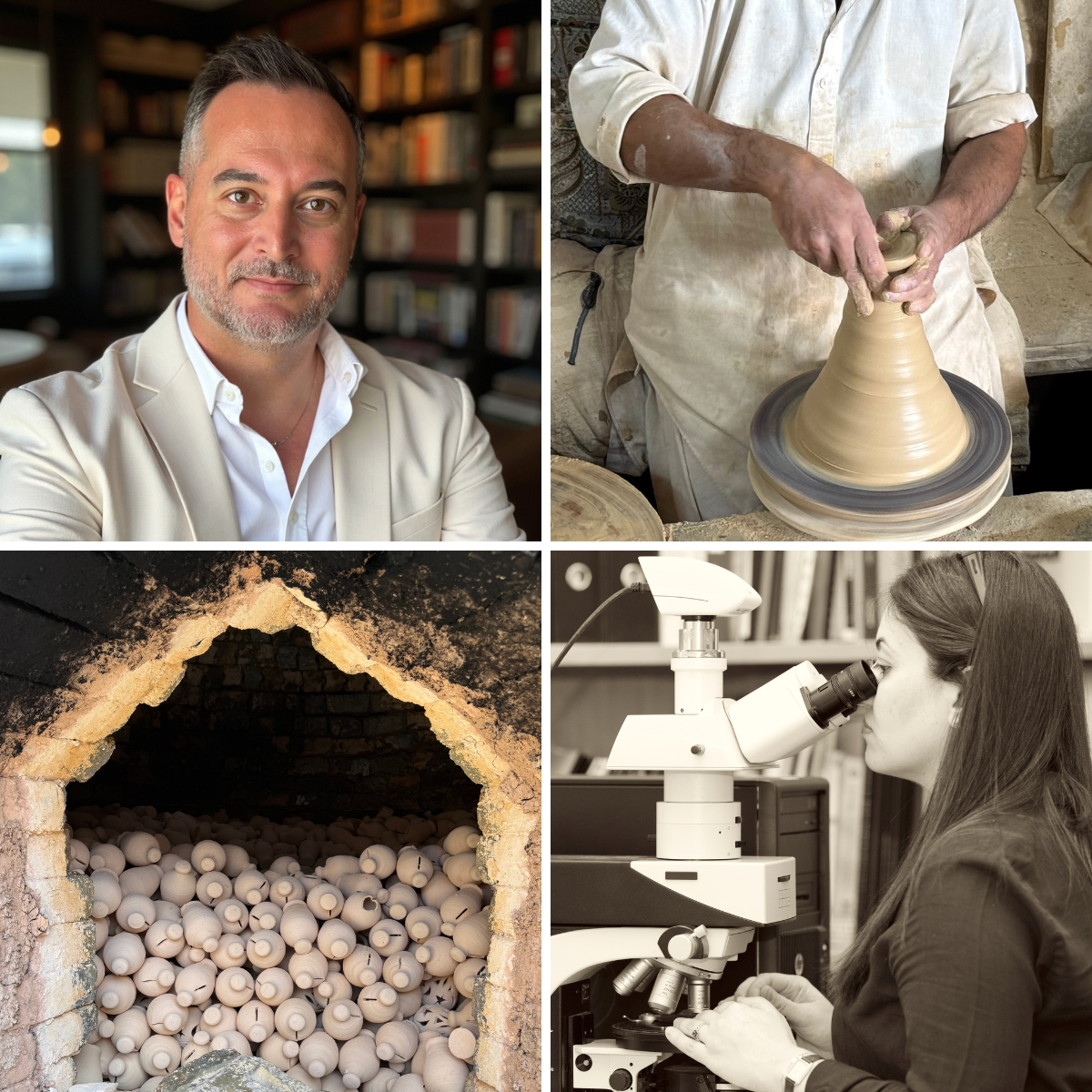
The network brings together archaeometric analysis, experimental archaeology, archaeological interpretation and artificial intelligence. Doctoral researchers will reconstruct ancient production techniques in the laboratory. They will also develop AI-assisted methods to link and interpret large datasets on materials, technologies, and the various stages of ceramic production.
A European consortium with a global research reach
SOPHIA-DN unites 20 organisations: eight beneficiaries in six EU Member States and twelve associated partners. The partners include universities, research institutes, heritage authorities, a pottery studio and a technology company. The beneficiaries are the University of Cyprus (coordinator), The Cyprus Institute, the University of Padua (Italy), the University of Patras (Greece), the University of Santiago de Compostela (Spain), University College Dublin (Ireland), the French National Centre for Scientific Research (CNRS, France) and the University of Pisa (Italy). The associated partners are based in Cyprus, Greece, France, Germany, Italy, the Czech Republic, and Bahrain.
The research spans from the Neolithic to the post-medieval period. Case studies extend from Cyprus, Greece, Italy, France, Germany, Ireland and the Czech Republic to Morocco, West Africa, the Horn of Africa, and Bahrain. This breadth provides a unique comparative basis for studying how ceramic technologies developed and spread across Europe, the Eastern Mediterranean, Africa and the Arabian Gulf.
15 doctoral researchers, one integrated methodology
The network will recruit 15 doctoral candidates, hosted at some of Europe’s foremost centres of archaeometry and archaeological science. Each will be co-supervised by experts from different disciplines (e.g., archaeology, geology, geochemistry, computer science). They will use a wide range of methods, spanning mineralogical, geochemical and isotopic techniques, microstructural and experimental approaches, micro-CT and 3D scanning, ethnographic fieldwork and machine learning. Shared training courses, research secondments and public outreach events will give them skills for careers both within and beyond academia.
Timeline
SOPHIA-DN officially starts on 1 March 2027. Doctoral candidates will be recruited between September and November 2027, in line with each host institution’s admission procedures. Vacancies will be advertised internationally on EURAXESS and on the websites and social media channels of the project and its beneficiaries. They will be filled through an open, transparent and merit-based process, in accordance with the European Charter for Researchers and the Code of Conduct for the Recruitment of Researchers.
Commenting on the success of SOPHIA-DN, Dr Vionis and Dr Dikomitou-Eliadou argued that “potters across the ages have held a remarkable body of knowledge about materials and techniques. By combining laboratory science, experimental archaeology, and artificial intelligence within such a strong consortium, SOPHIA-DN will allow us to recover part of that knowledge and understand the people behind ceramic production, decoding the ceramic heritage of distinct regions of the world.”
About the Marie Skłodowska-Curie Actions
The Marie Skłodowska-Curie Actions are the European Union’s flagship programme for doctoral education and postdoctoral training. MSCA Doctoral Networks fund partnerships of universities, research organisations and other sectors. They train doctoral candidates through international, interdisciplinary and intersectoral mobility.
SOPHIA-DN is funded by the European Union under grant agreement No 101312286 (call HORIZON-MSCA-2025-DN-01). 